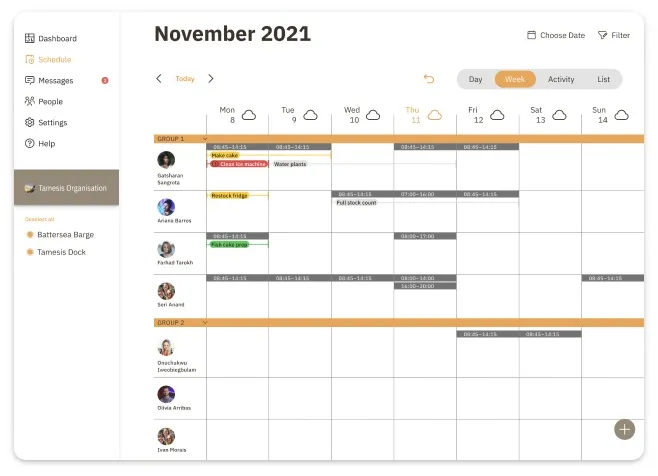
Project Overview: The Robin’s Hood web app was designed to facilitate seamless collaboration, record-keeping, and communication for businesses. My role focused on UX design and development management to ensure the platform was intuitive, scalable, and efficient. Using a modular design, I prioritized user needs while managing the development process with a database-driven system to track features, bugs, and testing.
UX Design Process:
-
User-Centric Approach:
- Conducted research to understand key user workflows, focusing on three main functionalities: record-keeping, project management, and communication.
- Designed a customizable dashboard to provide an overview of critical information, tailored to individual user needs.
- Developed a modular structure allowing users to enable or disable features, keeping the interface simple and relevant.
-
Intuitive Navigation:
- Created a clear hierarchy for the app’s main modules: Dashboard, Records, Communication, and Directory.
- Incorporated visual cues and feedback mechanisms to guide users through workflows, reducing the learning curve.
-
Accessibility and Flexibility:
- Ensured the app supported third-party integrations and API connections, allowing businesses to adapt the tool to their specific needs.
- Designed a privacy-first account system enabling multiple profiles per user, each with distinct permissions and data visibility.
Development Management:
-
Database for Feature Tracking:
- Set up a centralized database to document feature requests, their development status, and priority levels.
- Organized features by module (e.g., Records, Communication) to align with the app’s modular design philosophy.
-
Bug and Issue Tracking:
- Implemented a bug-tracking system linked to the database, enabling the team to log, categorize, and resolve issues efficiently.
- Categorized bugs by severity and impact, ensuring critical issues were addressed promptly.
-
Collaborative Development Workflow:
- Established a Git-based workflow with version control and branch management for feature development.
- Conducted regular code reviews to maintain high-quality standards and foster team collaboration.
-
Testing and Quality Assurance:
- Developed a comprehensive testing framework to validate new features and fixes.
- Scheduled regular user testing sessions to gather feedback on the app’s usability and identify areas for improvement.
Key Outcomes:
- Delivered an app with a highly customizable interface, balancing complexity and usability.
- Achieved efficient team collaboration and issue resolution through the database-driven management approach.
- Received positive feedback from stakeholders on the app’s intuitive design and modular functionality.
Tech Stack:
- Framework: React (for the front end)
- Design Tools: Figma, Adobe XD
- Development Tools: Git, GitHub
- Project Management: Custom database system
- Hosting: AWS